A repo for contest submission
| .config | ||
| Controllers | ||
| image/README | ||
| Models | ||
| Properties | ||
| Services | ||
| .gitignore | ||
| appsettings.Development.json | ||
| appsettings.json | ||
| Program.cs | ||
| README.md | ||
| StitcherApi.csproj | ||
| StitcherApi.http | ||
| StitcherApi.sln | ||

Image Stitcher API by Benscode (Ibnu Fadhil)
Introduction
Image Stitcher API is the solution for the Stitch-a-ton Contest by Mas Adin. The implementation emphasizes correctness, performance optimization, and code clarity.
1. System Setup and Deployment
Prerequisites
- .NET 8 SDK or newer.
Development Environment Setup
-
Clone the Repository
git clone https://null.formulatrix.dev/benscode/benscode-StitcherApi.git cd benscode-StitcherApi -
Configure Image Assets
- Create an
assetsfolder in the project root. - Place your image tiles in this folder.
- Optionally set the environment variable
ASSET_PATH_ROto override the asset path.
- Create an
-
Run the Application
dotnet runThe API will be hosted locally at:
http://localhost:5229
Production Environment Deployment
-
Publish the Application
dotnet publish -c Release -r linux-arm64 --self-contained true -
Transfer the publish directory to the server.
-
Configure Asset Path
export ASSET_PATH_RO="/path/to/your/image-tiles" -
Execute the Application
chmod +x ./StitcherApi
./StitcherApi
2. API Specification
Endpoint:
POST /api/image/generate
Request Body (application/json):
{
  "canvas_rect": "A1:H12",
  "crop_offset": [0.25, 0.25],
  "crop_size": [0.5, 0.5],
  "output_scale": 1.0
}
Parameters
- canvas_rect: Defines the bounding box of tiles forming the canvas.
- crop_offset:
[x, y]normalized offset from top-left. - crop_size:
[width, height]normalized size relative to the canvas. - output_scale: Scale factor for the final cropped image.
Responses
- 200 OK – Returns the generated PNG image.
- 400 Bad Request – Malformed request or invalid parameters.
- 404 Not found - Image not found
- 500 Internal Server Error – Unexpected processing error.
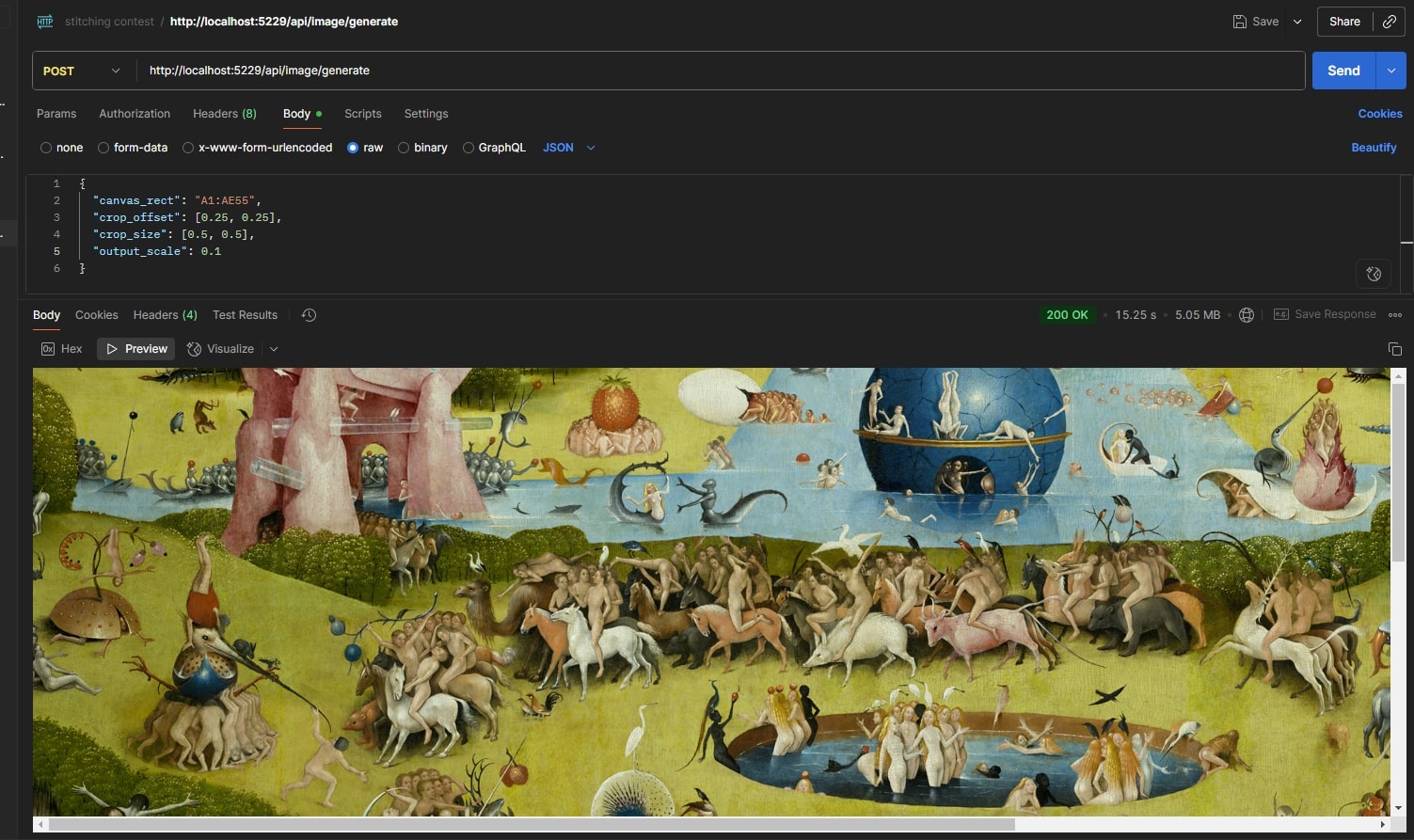
Response Example using Postman
3. System Architecture and Logic
The system uses a layered architecture:
- Program.cs – Application entry point.
- ImageController – Handles HTTP traffic.
- ImageService – Orchestrates business logic.
- Utility classes – Image parsing and processing.
Core Processing Logic
- Dimension Calculation: Compute canvas size without allocating memory.
- Absolute Crop Determination: Convert normalized crop to pixel coordinates.
- Minimal Tile Selection: Load only tiles intersecting with the crop.
- Integrated Stitch and Crop: Copy relevant pixels directly to final canvas.
- Final Scaling and Encoding: Scale and encode to PNG for the response.
Optimization:
- Avoids creating large intermediate images.
- Processes one tile at a time for low memory usage.
4. Performance Analysis
-
Time Complexity:
O(W_crop * H_crop)Dependent on cropped image size, not full canvas size. -
Space Complexity:
O(W_crop * H_crop + W_tile * H_tile)- Memory for final image + one 720x720 tile at a time.
- Predictable and low memory footprint.